Home
Timothy A. Myers
Associate Research Scientist · Department of Atmospheric Science · University of Wyoming
I study how low clouds respond to warming and how their response shapes Earth’s energy budget and climate sensitivity. I combine satellite and ground-based observations with climate-model experiments to identify cloud processes, evaluate model uncertainty, and understand climate variability.
View publications tmyers12 [at] uwyo.edu

Research
Cloud feedbacks
How do low clouds respond to warming, and what can observations tell us about Earth’s climate sensitivity?
Model uncertainty
Which physical processes drive uncertainty in simulated low clouds? Perturbed-parameter ensembles help identify the model assumptions that matter most.
Climate variability
How do clouds and ocean temperatures interact, from regional marine heatwaves to basin-scale climate variability?
Boundary-layer processes
How well do models represent clouds, thermodynamic structure, and winds within the atmospheric boundary layer?
Field observations
Across WFIP3 and PERiLS/VORTEX-USA, I contributed to field operations and instrument maintenance, and I analyzed ground-based boundary-layer observations from those campaigns and CHEESEHEAD19. For WFIP3, I also co-developed the campaign’s 19-month event log documenting East Coast weather regimes and the occurrence of marine fog.
Selected findings
2026 · Geophysical Research Letters
Model physics shape stratocumulus sensitivity
Across an E3SMv3 perturbed-parameter ensemble, the mean cloud state strongly regulates stratocumulus radiative sensitivity, while rain formation emerges as a key microphysical control. The simulations also reveal a structural bias in the response to surface temperature advection.
2026 · Communications Earth & Environment
Recent cloud changes reinforce established constraints
Meteorology and declining sulfate aerosols explain recent low-cloud trends and the extreme 2023 anomaly, supporting established bounds on cloud feedback, aerosol–cloud interactions, and climate sensitivity.
2021 · Nature Climate Change
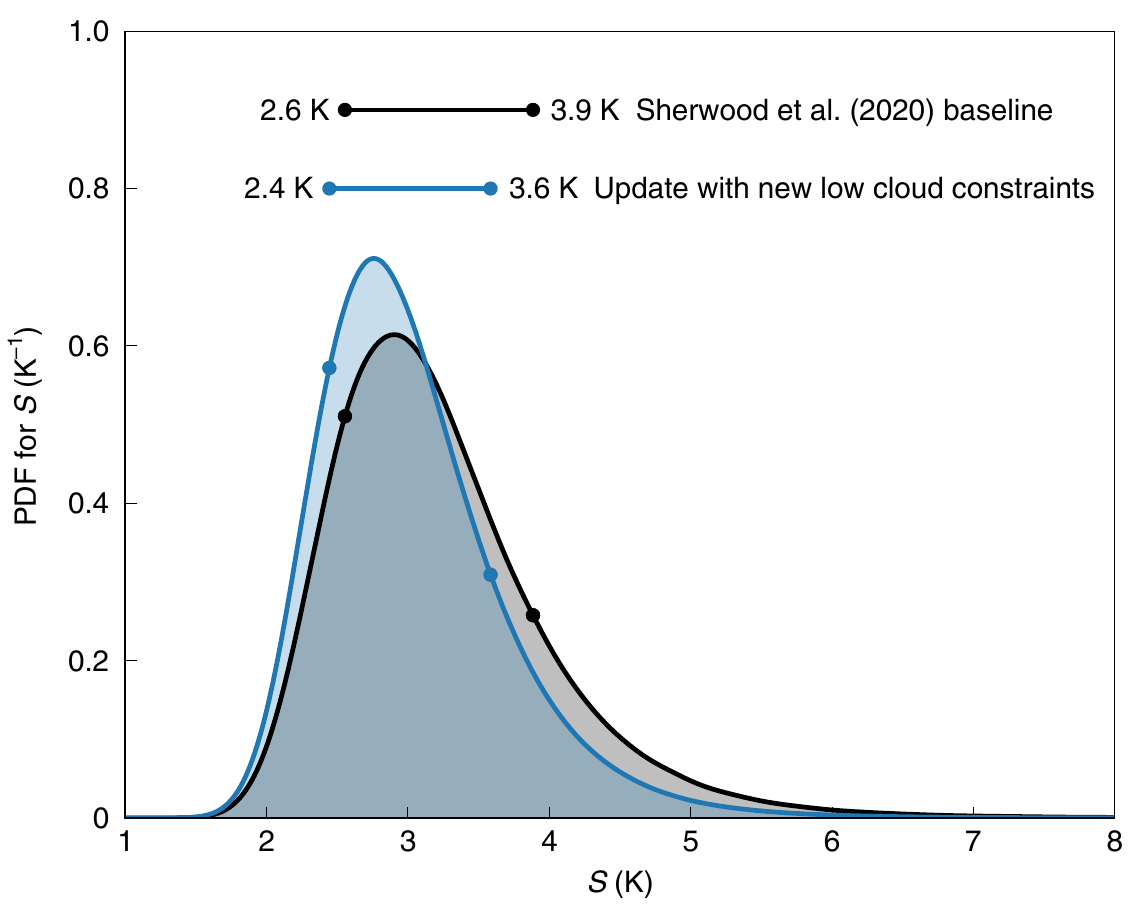
Observations narrow uncertainty in climate sensitivity
Relationships between clouds and their environment provide observational constraints on how low clouds respond to warming.
Observational constraints on low cloud feedback reduce uncertainty of climate sensitivity
Featured in Nature Climate Change’s 15th-anniversary retrospective on influential papers.
2023 · Journal of Climate
The pattern of warming matters
Observations help constrain how the spatial pattern of ocean warming affects cloud feedback.
Observational constraints on the cloud feedback pattern effect
2018 · Geophysical Research Letters
Clouds helped amplify a marine heatwave
Reduced cloud cover and increased solar heating helped amplify the unprecedented 2014–2015 marine heatwave in the eastern Pacific Ocean.
Media & recognition
Selected reporting that features my work on clouds, climate sensitivity, model uncertainty, and atmospheric observations.
Nature Climate Change · 15th anniversary · 2026
Early-career researchers reflect on influential papers
My 2021 paper Observational Constraints on Low Cloud Feedback Reduce Uncertainty of Climate Sensitivity was featured in Nature Climate Change’s 15th-anniversary retrospective on influential papers.
Energies Media · 2026
DOE and NOAA researchers release 19-month offshore weather event log
Eos · GRL 50th anniversary · 2024
Challenges in evaluating climate sensitivity from climate models
The Washington Post · 2022
One of climate change’s great mysteries is finally being solved
Scientific American · 2021